{"@context":"https://schema.org","@graph":[{"@type":"BlogPosting","@id":"https://www.rivertreewealth.com/blog/aca-subsidies-vs-roth-conversions#article","headline":"ACA Subsidies vs. Roth Conversions: Which Wins Before Age 65?","description":"Should early retirees keep income low for ACA subsidies or do Roth conversions? A hypothetical case study shows how to weigh the tax valley trade-off.","image":"https://i.ytimg.com/vi/WHo4WXb8_2A/maxresdefault.jpg","datePublished":"2026-09-02T22:00:16.000Z","dateModified":"2026-09-02T22:00:16.000Z","mainEntityOfPage":"https://www.rivertreewealth.com/blog/aca-subsidies-vs-roth-conversions","url":"https://www.rivertreewealth.com/blog/aca-subsidies-vs-roth-conversions","author":{"@type":"Person","name":"Jacob Duke, CFP®","jobTitle":"Founder & Lead Advisor","url":"https://www.rivertreewealth.com/about-us","sameAs":["https://www.youtube.com/@RetirementAnswers","https://www.linkedin.com/in/jacobduke/","https://open.spotify.com/show/6a5BQ6ezlhiVyNyW5uxW16"]},"publisher":{"@type":"Organization","name":"Rivertree Wealth","url":"https://www.rivertreewealth.com","logo":{"@type":"ImageObject","url":"https://cdn.prod.website-files.com/682605e780a05a1c8f5c3928/68a23248df703dcdcfe0ed7c_Rivertree%20Logo%20Full%20-%20Primary%20Color.png"}},"articleSection":"Roth Conversions","keywords":"ACA Subsidies vs. Roth Conversions Before 65"},{"@type":"FAQPage","@id":"https://www.rivertreewealth.com/blog/aca-subsidies-vs-roth-conversions#faq","mainEntity":[{"@type":"Question","name":"Are ACA subsidies based on taxable income or MAGI?","acceptedAnswer":{"@type":"Answer","text":"ACA premium subsidies are based on modified adjusted gross income (MAGI), not taxable income. That means income that is barely taxed, such as an IRA withdrawal sheltered by the standard deduction, can still push premiums up. In one hypothetical example, an extra $40,000 IRA withdrawal added only about $1,000 of federal tax but raised a gold plan from about $90 to $471 per month."}},{"@type":"Question","name":"What is the ACA subsidy cliff in 2026?","acceptedAnswer":{"@type":"Answer","text":"For 2026, ACA premium subsidies are available only up to 400% of the federal poverty level. For a married couple in a two-person household, that is roughly $83,000 to $84,000 of income. Above that line the subsidy disappears entirely, so even a few dollars of extra income, from a Roth conversion for example, could cost a pre-Medicare retiree thousands of dollars a year in premiums."}},{"@type":"Question","name":"Should early retirees do Roth conversions if it means losing ACA subsidies?","acceptedAnswer":{"@type":"Answer","text":"It depends on the size of your future tax problem versus the subsidies you would give up. In one hypothetical case, a 62-year-old couple paid roughly $36,000 in extra premiums over three years to convert to the top of the 10% bracket, with about $100,000 in projected lifetime tax savings. The math favored converting, but it is a personal decision that depends on your numbers."}},{"@type":"Question","name":"What is the tax valley in retirement?","acceptedAnswer":{"@type":"Answer","text":"The tax valley is the period after you stop working but before Social Security and required minimum distributions begin, when taxable income can be very low. Retirees living on cash and brokerage accounts may owe little or no federal tax in these years. It can be a window for Roth conversions, but for people under 65 on ACA coverage it also affects health insurance subsidies."}},{"@type":"Question","name":"What is the widow's tax trap?","acceptedAnswer":{"@type":"Answer","text":"The widow's tax trap happens when one spouse dies and the survivor starts filing as a single taxpayer with narrower brackets. Using 2026 brackets, a married couple can have up to $211,000 of taxable income in the 22% bracket, while a single filer passes that bracket at $105,000. With similar IRA withdrawals or RMDs, the survivor's tax rate may rise noticeably."}}]},{"@type":"VideoObject","@id":"https://www.rivertreewealth.com/blog/aca-subsidies-vs-roth-conversions#video","name":"The Tax Valley Dilemma: What Early Retirees Need to Know","description":"Keep income low for cheap ACA health insurance, or use the early retirement tax valley for Roth conversions? A hypothetical 62-year-old couple shows how to weigh the trade-off.","thumbnailUrl":"https://i.ytimg.com/vi/WHo4WXb8_2A/maxresdefault.jpg","uploadDate":"2026-09-02T22:00:16.000Z","duration":"PT23M14S","embedUrl":"https://www.youtube.com/embed/WHo4WXb8_2A","contentUrl":"https://www.youtube.com/watch?v=WHo4WXb8_2A"}]}
Blog Category

ACA Subsidies vs. Roth Conversions: Which Wins Before Age 65?

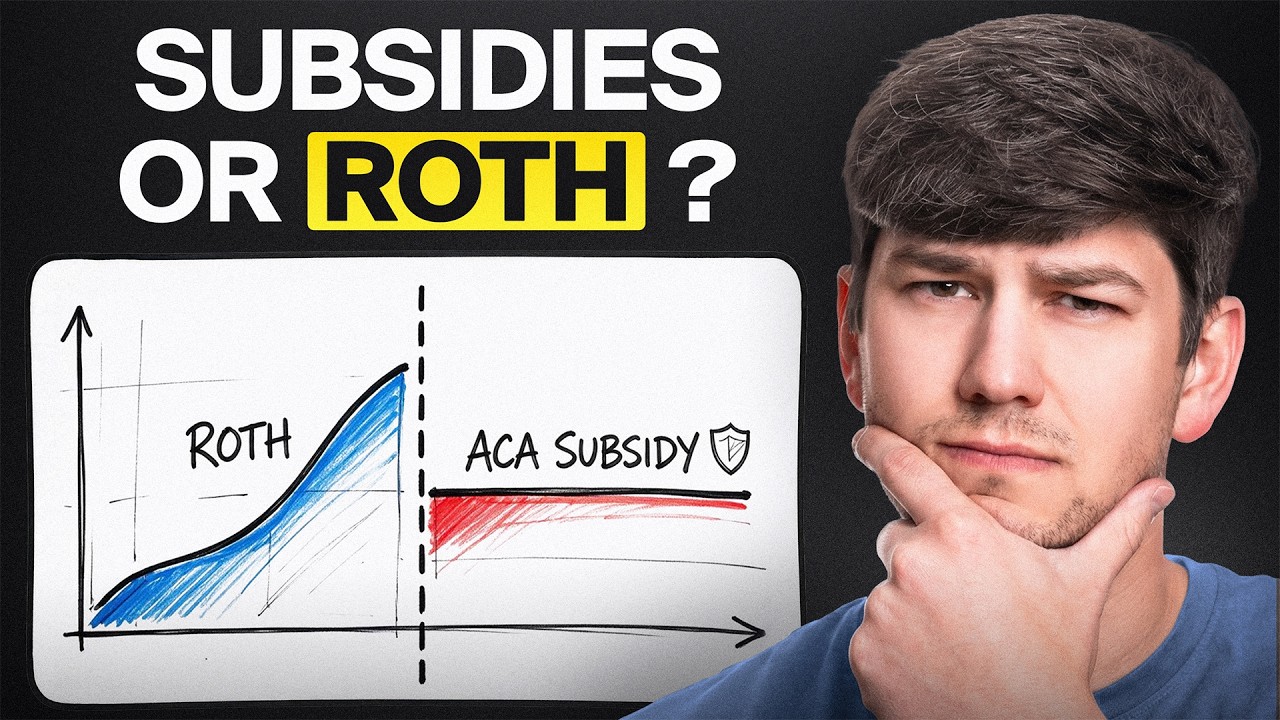
Keep income low for cheap ACA health insurance, or use the early retirement tax valley for Roth conversions? A hypothetical 62-year-old couple shows how to weigh the trade-off.

Watch on YouTube Listen to the podcast

Key takeaways

  • ACA premium subsidies are based on modified adjusted gross income (MAGI), not taxable income, so income that is barely taxed can still raise health insurance premiums significantly.
  • In this hypothetical, a 62-year-old couple with about $30,000 of income was at roughly 142% of the poverty level and could get a gold plan for about $89 per month, with about $993 per month in subsidies.
  • For 2026, ACA subsidies stop entirely above 400% of the federal poverty level, around $83,000 to $84,000 of income for this two-person household.
  • Roth conversions filling the 10% bracket pushed the couple over the cliff, costing roughly $36,000 in extra premiums over three years in exchange for about $100,000 in projected lifetime tax savings.
  • Converting slightly less to stay under the 400% line could preserve part of the subsidy, so the exact conversion amount matters.

If you retire before 65, you may face a choice that surprises a lot of people: keep your income low so you qualify for big health insurance subsidies, or use those low-income years for Roth conversions to shrink your future tax bill.

I see this tension often with clients who retire in their early 60s. They know a tax bill is waiting for them later, but paying thousands more in health insurance premiums today feels painful.

In this article, I'll walk through a hypothetical couple, Doug and Sarah, to show how ACA subsidies, the "tax valley," and Roth conversions interact, and how you might think about the trade-off in your own plan.

What is the tax valley in early retirement?

The tax valley is the stretch of years after you stop working but before Social Security and required minimum distributions (RMDs) begin, when your taxable income can be unusually low. It can be a real opportunity, but it comes with trade-offs if you buy health insurance on the ACA marketplace.

A hypothetical case study: Doug and Sarah

In this illustrative example, Doug and Sarah are both 62, live in Ohio, and retired at the end of 2025, so 2026 is their first full year of retirement. Their net worth is about $2.1 million and they have no debt.

  • Cash in the bank: $46,000
  • Doug's IRA: about $865,000
  • Sarah's rollover IRA: $540,000
  • Joint brokerage account: $240,000, with a cost basis of $185,000
  • Home: worth about $475,000, paid off

They spend about $5,500 per month. They also want to take the whole family on a trip for their 40th anniversary in 2029, which I budgeted at $30,000. Social Security is set to start at 67, and after 65 they plan to use Medicare Parts B and D plus a Medigap policy.

How they could pay $0 in federal income tax

Even with about $68,000 of annual spending, Doug and Sarah's projected federal tax for 2026 is $0. That's because the projection funds their spending from the brokerage account first, and only the gains, interest, and dividends show up as income.

Their projected 2026 return shows about $20,612 of long-term capital gains plus some interest and dividends, for an adjusted gross income of about $28,000 (I round it to $30,000). With a 2026 standard deduction of about $32,000 for married couples filing jointly, their taxable income is zero.

How can health insurance before 65 be so cheap?

Health insurance before 65 can be very inexpensive when your income is low, because ACA premium subsidies are based on household income. In this example, I estimated their premiums at just $1,000 per person for 2026.

Using a marketplace pricing tool for Doug (a 62-year-old in Ohio, married filing jointly) with $30,000 of household income, a bronze plan could cost $0 per month and a gold plan about $89 per month. At that income they're at roughly 142% of the federal poverty level and receive about $993.47 per month in subsidies, which means the same plans could cost over $1,000 per month without help.

Sarah's pricing may differ somewhat, but I assumed equal costs to keep the example simple.

Why do taxes go up later in retirement?

Taxes often rise later in retirement because the low-tax savings run out and more income has to come from fully taxable IRA withdrawals, followed by RMDs. In Doug and Sarah's projection, the brokerage account and cash are used up by 2030.

That year, they would take about $94,000 from their IRAs, all of it taxable, and owe roughly $6,000 in federal tax (state tax would add a bit more). This happens after 65 but before Social Security starts.

Once Social Security begins, their tax bill may drop again. Anywhere from 0% to 85% of benefits can be taxable, depending on your other income. In 2033, for example, the projection shows about $105,000 of combined benefits with only $13,461 of it taxable.

The bigger jump comes when RMDs begin at 75 for them. That's the future tax problem many people in their situation are worried about.

The widow's tax trap

If one spouse passes away, the survivor generally files as a single taxpayer, and the brackets shrink. Using the 2026 brackets, a married couple filing jointly can have up to $211,000 of taxable income in the 22% bracket, but a single filer moves past the 22% bracket at just $105,000.

In this hypothetical, if Doug passed away at 80, Sarah's effective federal tax rate could climb to about 17% or more, and roughly 18% to 19% once state taxes are included. Reducing that risk for the surviving spouse is one reason many people consider Roth conversions.

What income counts for ACA subsidies?

ACA subsidies are based on modified adjusted gross income (MAGI), not taxable income. That distinction matters, because income that is barely taxed can still raise your health insurance premiums significantly.

In one scenario, I had Doug and Sarah withdraw an extra $40,000 per year from their IRA starting in 2027 until they reach 65, while spending the same amount. Their income rose to about $60,000, but their taxable income was only about $26,000, so the federal tax on that extra $40,000 was roughly $1,000. That's a very low tax rate.

The real cost showed up in health insurance. At $60,000 of MAGI, they moved from about 142% to 284% of the poverty level, their subsidy fell to around $600 per month, and the gold plan went from about $90 per month to $471 per month. That premium increase is the "tax" they would actually feel.

The 2026 subsidy cliff

For 2026, ACA subsidies are available only up to 400% of the federal poverty level, which for this household is around $83,000 to $84,000 of income. Go over that line and the subsidy disappears entirely, which is why it's often called a cliff.

Are Roth conversions worth giving up ACA subsidies?

In this hypothetical, the math favored Roth conversions: roughly $36,000 in extra premiums in exchange for about $100,000 in projected lifetime tax savings. But it's a personal decision, and the numbers could look very different for your household.

I modeled conversions that fill the 10% bracket from age 62 until they reach Medicare at 65, roughly $52,000 to $57,000 per year. That's not a huge conversion, but the projection showed more after-tax assets at the end of their lives and roughly $100,000 in total tax savings.

Here's the catch. In 2026, a $52,000 conversion plus their brokerage withdrawals puts their income at about $84,642, just over the 400% line. They lose the entire subsidy, and premiums for the same plan go up by about $900 to $1,000 per month, or roughly $12,000 a year for three years.

Why the exact conversion amount matters

If they converted a little less and kept income around $83,000, they would stay under the cliff and keep a subsidy worth up to about $400 per month. Knowing how much to convert, and when, can make a real difference.

Questions to weigh

  • How large is your future tax problem, including RMDs and the widow's tax trap?
  • How much in subsidies would you give up, and for how many years before Medicare?
  • Could you fine-tune conversions to stay under the 400% cliff?
  • Do your health or family history change how you view the long-term payoff?
  • How will paying more now feel compared with tax savings you may not see until after 75?

In this example, the conversions didn't put their plan at risk. The hard part is emotional: you feel the higher premiums today, while the tax savings show up years later.

The bottom line

The early retirement tax valley could be one of the most valuable planning windows you'll have, but ACA subsidies make it more complicated. Income that looks cheap from a tax standpoint can become expensive once you factor in health insurance premiums.

There's no single right answer between keeping income low and doing Roth conversions. What matters is seeing the real numbers for your situation: your future tax picture, your subsidy cliff, and how much you could convert before crossing it.

If you're within five years of retirement and want a second set of eyes on your plan, see if you're a fit to work with Rivertree Wealth.

Frequently asked questions

Are ACA subsidies based on taxable income or MAGI?

ACA premium subsidies are based on modified adjusted gross income (MAGI), not taxable income. That means income that is barely taxed, such as an IRA withdrawal sheltered by the standard deduction, can still push premiums up. In one hypothetical example, an extra $40,000 IRA withdrawal added only about $1,000 of federal tax but raised a gold plan from about $90 to $471 per month.

What is the ACA subsidy cliff in 2026?

For 2026, ACA premium subsidies are available only up to 400% of the federal poverty level. For a married couple in a two-person household, that is roughly $83,000 to $84,000 of income. Above that line the subsidy disappears entirely, so even a few dollars of extra income, from a Roth conversion for example, could cost a pre-Medicare retiree thousands of dollars a year in premiums.

Should early retirees do Roth conversions if it means losing ACA subsidies?

It depends on the size of your future tax problem versus the subsidies you would give up. In one hypothetical case, a 62-year-old couple paid roughly $36,000 in extra premiums over three years to convert to the top of the 10% bracket, with about $100,000 in projected lifetime tax savings. The math favored converting, but it is a personal decision that depends on your numbers.

What is the tax valley in retirement?

The tax valley is the period after you stop working but before Social Security and required minimum distributions begin, when taxable income can be very low. Retirees living on cash and brokerage accounts may owe little or no federal tax in these years. It can be a window for Roth conversions, but for people under 65 on ACA coverage it also affects health insurance subsidies.

What is the widow's tax trap?

The widow's tax trap happens when one spouse dies and the survivor starts filing as a single taxpayer with narrower brackets. Using 2026 brackets, a married couple can have up to $211,000 of taxable income in the 22% bracket, while a single filer passes that bracket at $105,000. With similar IRA withdrawals or RMDs, the survivor's tax rate may rise noticeably.

Retirement Answers, in your inbox

Get Jacob's weekly retirement notes

One email a week with plain-English takeaways on taxes, Roth conversions, Social Security and spending in retirement. No spam. Unsubscribe anytime.

Thank you! Your submission has been received!
Oops! Something went wrong while submitting the form.
Share this article: LinkedIn Facebook X Email

Work with Rivertree

Want a second set of eyes on your retirement plan?

We help people 50+ with $1M or more saved build a retirement plan that coordinates taxes, income, Social Security and investments.

See if you're a fit

Important disclosure: This article is a written summary of a Retirement Answers video or podcast episode by Jacob Duke, CFP®, and is provided for general informational and educational purposes only. It is not personalized investment, tax, or legal advice, and it is not an offer or solicitation to buy or sell any security or to adopt any particular strategy.

Any case studies, examples, or projections are hypothetical and for illustrative purposes only. They do not represent actual client results, are not guarantees of future outcomes, and may not reflect your circumstances. Names and details are fictional or have been changed. Projections from planning software depend on assumptions that may not occur.

Tax laws, contribution limits, Medicare premiums, Social Security rules, and other figures change frequently. Information is believed to be accurate as of the original publish date shown above and may now be outdated. Investing involves risk, including the possible loss of principal, and past performance does not guarantee future results. Please consult a qualified financial, tax, or legal professional about your specific situation before acting.

Rivertree Wealth LLC is an SEC-registered investment adviser (CRD #329595). Registration does not imply a certain level of skill or training. Rivertree Wealth LLC does not provide legal advice. Additional information, including our Form CRS and Form ADV Part 2A, is available upon request and at adviserinfo.sec.gov.

No items found.