

Here's a problem I see with retirees that sounds like it shouldn't be a problem at all: they have too much money. They spend 30 or 40 years worrying about whether they're saving enough, finally get there with $1 million, $2 million, or maybe $3 million saved, and retire. Then the paycheck stops, and they don't spend near as much of it as they possibly could.
In my time as a retirement planner, I've seen this over and over again, and there's research to back it up. Under 20% of retirees would describe themselves as having a spending mindset, while far more say they have a savings mindset. They're retired, but mentally still saving for the very moment they're in.
Below, I cover why that switch is so hard, where the 4% rule falls short, and how a real plan may help you spend intentionally.
It's hard because your entire working life trained you to do one thing with your money: save it. Retirement asks you to reverse a habit you spent 30 years building.
Money went into your 401(k) automatically every month. Then one day you're retired, and planners like me basically say, "Great, you've made it. Now go start spending all of the money you've saved." That's a really hard adjustment.
Some caution is reasonable. You don't know how long you'll live, what healthcare will cost, or what the market will do next week. Nobody wants to get to 92 and realize they spent way too much money at 65, so naturally you build in some margin.
The problem is when that margin becomes so large you sacrifice the years you could have enjoyed the money.
Often it's because your investment growth is greater than what you're taking out as a percentage of your portfolio. That doesn't mean your plan was wrong. It's just how the math can work out.
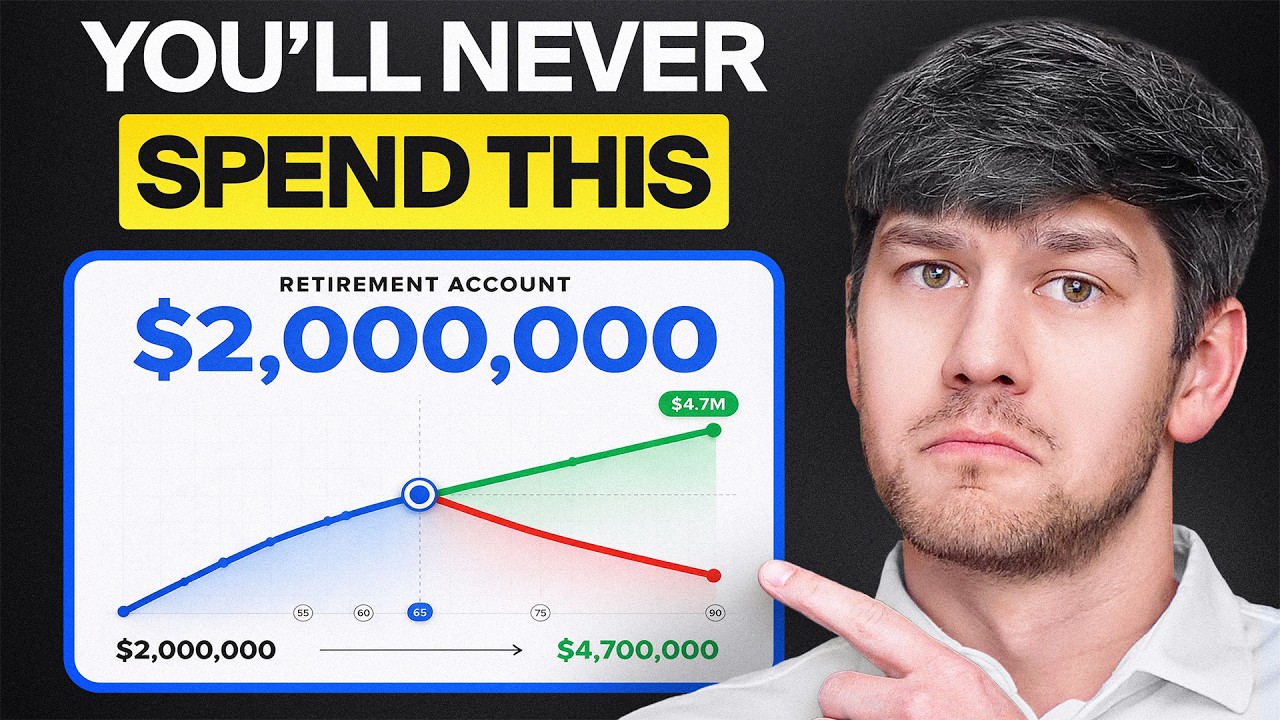
Consider a hypothetical retiree with $2 million. They take reasonable draws every year, Social Security eventually kicks in, and maybe there's a pension. If the portfolio earns a reasonable return, they might spend from it for 5 or 10 years, then look up and say, "Hey, I still have $2 million."
The 4% rule answers a different question. It was primarily designed to answer "How much can I withdraw while having a very high probability of never running out of money?" not "How much should I spend to get the most enjoyment out of my retirement?"
Retiring with $2 million and using 4% gives you $80,000 in year one, traditionally adjusted for inflation moving forward. That's a good starting point. But if your entire plan is built around maximizing the probability that you never run out of money, you shouldn't be surprised if you end up dying with a lot of money one day.
Required minimum distributions often show the same pattern. Someone gets into their 70s, their IRAs have kept growing, and the IRS says, "Hey, you've got to start taking money out."
Many don't need all of that money. They take the RMD, pay the tax, and then, more often than you'd think, reinvest the rest in a brokerage account. The money didn't get spent. It just moved from one account to another.
That's usually a good indication the question was never whether they had enough. It was whether they gave themselves full permission to actually use it.
Yes. Your ability to enjoy money isn't constant throughout retirement, and research generally shows spending tends to decline as retirees get older, particularly when adjusted for inflation.
I often talk about the go-go years, slow-go years, and no-go years. Your 60s are not going to look like your 80s. At 62 or 65, you might want to:
At 85, you probably won't want to do those things, or even worse, you might not physically be able to. If you keep telling yourself "I'll spend the money later," there may come a point where later arrives and you don't actually want to spend it anymore.
In my view, no. No one gets a reward for dying with $2 million instead of $1 million one day.
To be clear, I'm not suggesting anyone retire at 60 and start blowing through their portfolio because some spreadsheet, or even I, said they could. That's not good planning.
I'd rather see you spend the money and enjoy it because you've figured out how to think about money properly: money as a tool more than a metric, something that can bring purpose and fulfillment to your life rather than something that just shows up on a balance sheet.
A good, real financial plan is what may give you that answer. Saying "Hey, I've got $2 million and I'm fine" isn't enough.
A thorough plan accounts for everything that doesn't show up in a simple 4% rule calculation, including:
Next comes projecting your money over time. In this hypothetical example, you're 65 with $2 million today, and a reasonable projection says you could have $4 million or $5 million at age 90.
That's helpful, because maybe that's exactly what you want. If leaving several million dollars to your kids or grandkids is incredibly important to you, the plan can show you're on track for that.
But if you told me, "I don't really care about leaving a huge inheritance. I want my kids to be okay, but I want to enjoy the money I worked for," we'd probably need a different conversation. Options could include:
Or maybe nothing changes, and that extra margin is what lets you sleep at night. What matters is making these decisions intentionally instead of automatically spending less simply because you're afraid of running out.
Periodically. One of the best things you can do in retirement is give yourself permission to re-evaluate.
Imagine a hypothetical retiree who retired five years ago with $2 million and today has $2.5 million, even after withdrawals. They now have a new set of information they didn't have 5 years ago.
That doesn't mean permanently increasing their lifestyle. But maybe this is the year for the big trip, helping the kids with a down payment, or creating experiences while everybody is healthy enough to enjoy them.
A retirement plan isn't just about managing your money. It's about managing your money along with your time and your life. Money is easy to measure, but you don't get a statement every month showing how much time you have left or how much fun you had.
That's why I think the biggest risk for some retirees isn't necessarily running out of money. It's reaching the end of retirement with a portfolio still worth millions and realizing they could have done so much more with it when they had the time and health to enjoy it.
The goal is not to die with zero, but it's also not to die with the biggest number possible. It's to use your money intentionally to create the retirement and the life you actually want, and a good financial plan should give you the confidence to do it.
If you're within five years of retirement and want a second set of eyes on your plan, see if you're a fit to work with Rivertree Wealth.
After 30 or 40 years of automatically saving, watching accounts grow and celebrating milestones, retirees are suddenly asked to do the opposite. Uncertainty about lifespan, future healthcare costs and markets adds to the hesitation. Research suggests under 20% of retirees see themselves as having a spending mindset, so many keep saving even though they are already retired, sometimes building a safety margin so large they sacrifice the years they could have enjoyed the money.
The 4% rule is a reasonable starting point for understanding withdrawals. With $2 million, it suggests $80,000 in the first year, adjusted for inflation afterward. But it was designed to answer how much you can withdraw with a very high probability of never running out of money, not how much to spend to get the most enjoyment from retirement. A plan built only on that goal may leave a retiree with far more money than they ever needed.
It is not unusual for investment growth to be larger than the percentage you withdraw each year. A hypothetical retiree with $2 million who takes reasonable withdrawals, collects Social Security and perhaps a pension, and earns a reasonable return could still have about $2 million after 5 or 10 years. That does not mean the plan was wrong; it is simply how the math can work, and it may indicate room to spend more.
Research generally shows retirement spending tends to decline as people age, especially in inflation-adjusted terms. Many people think of retirement in go-go, slow-go and no-go years. In your early 60s you may want to travel, golf several times a week or take the family on vacation, while at 85 you may not want to or be physically able to. Delaying spending until later can mean later arrives when the desire is gone.
A full financial plan goes beyond the account balance. It considers Social Security, expected expenses, taxes, healthcare costs before and after age 65, what happens if one spouse lives to 95 instead of 75, and the impact of a bad market decade early on. It then projects your wealth over time. If a hypothetical 65-year-old with $2 million is projected to have $4 million to $5 million at 90, they may have room to spend more.


